› Browse Recipes › New York Style Pastrami on Rye Sandwich
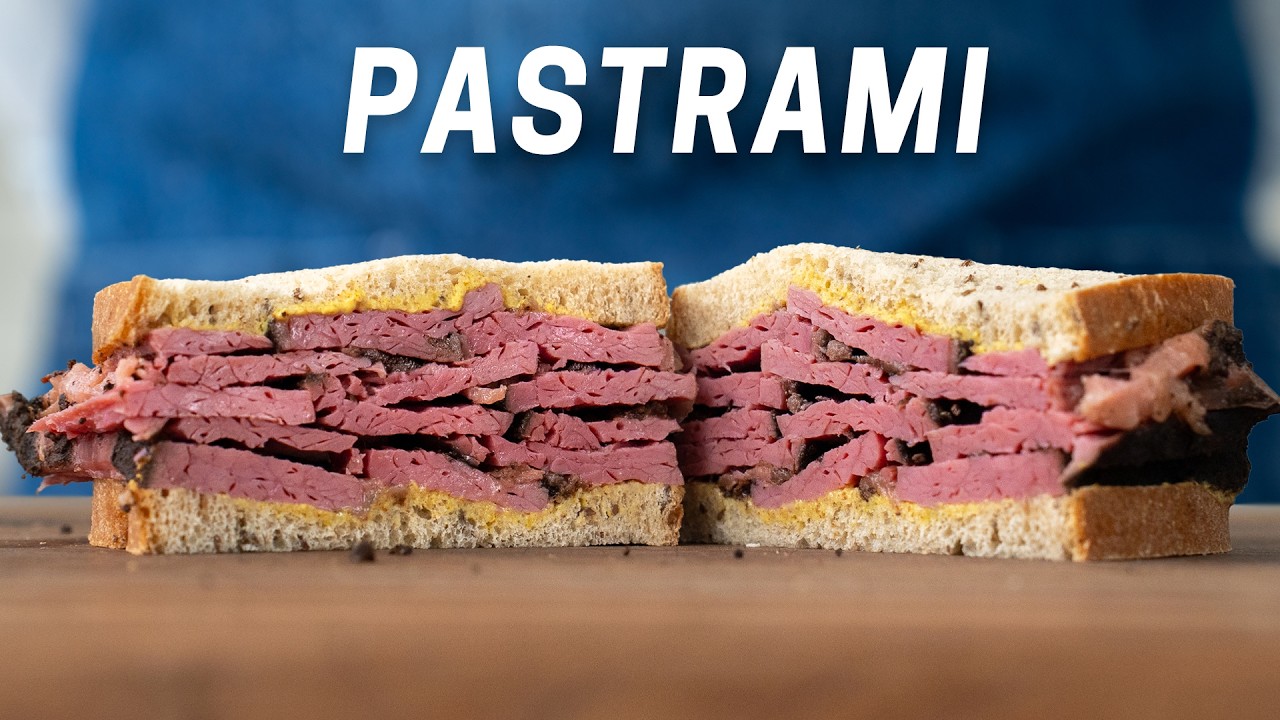
New York Style Pastrami on Rye Sandwich
A proper New York-style hot pastrami sandwich made by transforming store-bought corned beef brisket into deeply spiced, smoked, slow-roasted pastrami, sliced thick and stacked on Jewish caraway rye with spicy brown mustard. The recipe spans 2-3 days for a deli-quality result rivaling Lower East Side pastrami.
smart_display Published 2026-05-03
download Extracted 2026-05-04
Ingredients
For the Pastrami
- 5 lb corned beef brisket flat (rinsed and dried; 2 pieces of 2.5 lb each or 1 large piece)
- 30 g whole black peppercorns (toasted then coarsely ground)
- 30 g whole coriander seeds (toasted then coarsely ground)
- 30 g granulated sugar
- 5 g garlic powder
- 2 g chili flakes
- as needed wood chips (hickory or similar) (for the smoker box)
To Assemble the Sandwich
- 2 slices per sandwich Jewish caraway rye bread (store-bought (e.g., Pepperidge Farm Jewish Rye))
- to taste spicy brown mustard (spread edge to edge on both bread slices)
Steps
-
1Thoroughly rinse the corned beef under cold water and pat completely dry with paper towels.Tip: Drying ensures spices adhere properly to the meat surface.~5 min
-
2In a saute pan over medium-low heat, toast the whole coriander seeds and black peppercorns for 3-4 minutes until they take on a golden brown color and just begin to wisp smoke. Stir occasionally.Tip: Toasting opens the essential oils and adds 20-30% more spice flavor. Skip if pressed for time but you'll lose flavor depth.~4 min
-
3Transfer toasted spices to a blender. Place a paper towel under the lid to keep spice powder from escaping. Pulse on low speed for about 25 seconds until you reach a medium grind — between coarse crack and fine grind.Tip: Too coarse and the spices fall off the meat; too fine and they form a paste that won't develop bark. A spice grinder or mortar and pestle also work.~2 min
-
4Transfer ground spices to a small bowl and combine with 30g sugar, 5g garlic powder, and 2g chili flakes. Stir to combine.Tip: The sugar counterbalances the saltiness of the corned beef and adds perceived balance.~2 min
-
5Place the corned beef in a medium bowl. Spread half the rub over the first piece, pressing it firmly into every side to fully coat the meat. Repeat with the second piece and remaining rub. Aim for nearly 100% coverage.Tip: The spice-to-meat ratio is about 1:10. Don't worry if it looks like a lot — you need this much for proper pastrami flavor.~5 min
-
6Place the rubbed pastramis on a wire rack set over a sheet tray. Refrigerate uncovered for 12-24 hours (or 8-12 hours minimum). This develops the pellicle — a sticky protein layer essential for capturing smoke flavor.Tip: Don't skip — without a pellicle, smoke wafts over the meat instead of infusing. Wet meat smoked directly tastes like an ashtray.~720 min
-
7Set up a gas grill (or charcoal grill) for indirect smoking: turn one side burner to high, leave the other side off. Place a smoker box with a couple handfuls of dry wood chips directly on the heating element of the hot side. Close the lid and let it come up to a smolder for 15-20 minutes (target 225-250F internal grill temp).Tip: Type of wood doesn't matter much — the spice rub and corned beef flavor dominate. Dry chips smolder faster than soaked ones.~20 min
-
8Place the rubbed pastramis on the cool (off) side of the grill. Close the lid and smoke for 90 minutes total, replacing wood chips 2-3 times (every 25-35 minutes) to maintain a steady smoke. Smoke until you see a reddish-brown bark form on the exterior.Tip: Keep the temperature in the medium-low range. Too hot causes the protein to seize and squeeze out moisture, and produces harsh campfire smoke instead of sweet smoke.~90 min
-
9Bring the pastramis inside and wrap each piece tightly in a double layer of aluminum foil, sealing well to trap steam.Tip: This approximates the steaming step that delis like Katz's use to keep their pastrami moist and to melt collagen.~5 min
-
10Place the foil-wrapped pastramis in a 300F (150C) oven and slow-roast for about 4 hours initially. Check at 3.5 hours by inserting a thermometer — target around 200-205F internal. Then continue cooking another 1-1.5 hours (4.5-5 hours total) for collagen to melt into gelatin.Tip: Reaching 200-205F is not enough — you must HOLD that temperature for 1.5-2 hours for the collagen to fully melt.~270 min
-
11Test for doneness with two forks: pull at the meat — it should be yielding and could shred if you wanted to, but should still hold together cohesively (not falling apart). If it feels firm or tight, give it another 30-90 minutes.Tip: Sweet spot: tender enough to pull but still holds form. Past that, the fibers contract and squeeze out the gelatin, leaving you with dry, ropey meat.~5 min
-
12Rest the pastrami for at least 45 minutes before slicing. For best results, let it cool to room temperature, refrigerate overnight, then reheat in a 350F oven to 135F internal the next day — this gives more structural integrity for clean slices.Tip: Hot pastrami sliced immediately tends to fall apart. Overnight rest is the deli secret for clean thick slices.~45 min
-
13Slice the pastrami AGAINST THE GRAIN (perpendicular to the muscle lines) into thick quarter-inch slices. Plan on about 8 oz (half a piece) of pastrami per sandwich.Tip: Thick slices give a meatier eating experience than the thin deli slices — closer to Katz's or Montreal smoked meat style.~5 min
-
14For each sandwich, take two slices of Jewish caraway rye. Spread a generous spoonful of spicy brown mustard edge-to-edge on both slices.Tip: Spicy brown over yellow (too sour), grainy (too crunchy), or Dijon (overpowering). Pepperidge Farm Jewish Rye holds up well.~1 min
-
15Shingle the warm pastrami slices over one piece of bread, building an even layer side-to-side. If end pieces are sparse, cut and stack pieces to even out the height. Aim for a 4:1 meat-to-bread ratio (roughly 8 oz / 1.5-2 inches of meat).Tip: Trim some fat cap if needed — a little is delicious but too much makes the sandwich heavy.~2 min
-
16Place the second slice of mustard-covered rye on top. Press down gently and tuck in the sides to flatten the mound and improve eating experience. Slice in half and serve immediately while warm.Tip: The downward press evens out the meat and makes the sandwich easier to bite without slipping apart.~1 min
Nutrition (per serving)
580
Calories
38g
Protein
32g
Carbs
32g
Fat
3g
Fiber
Cultural Context
Pastrami on rye is the signature sandwich of New York Jewish delicatessens, perfected over generations at iconic establishments like Katz's Deli on the Lower East Side. Brought by Eastern European Jewish immigrants in the late 19th century, pastrami originated as a method to preserve beef using brining, spicing, and smoking — adapted from Romanian 'pastrama' (originally goose). The classic deli preparation steams the smoked brisket to keep it moist, slices it thick by hand, and serves it on caraway rye with spicy brown mustard. Brian's recipe approximates the Katz's steaming step using a foil wrap during oven roasting.