› Browse Recipes › How to Use a Knife Like a Professional — Cutting Techniques and Safety
How to Use a Knife Like a Professional — Cutting Techniques and Safety
A professional tutorial on kitchen knife skills covering proper posture, correct grip, three fundamental cutting techniques (free-fall, rocking/pivot, and tip-drag), knife safety rules, and the importance of conscious practice. Victor demonstrates cutting blindfolded to illustrate true mastery.
download Extracted 2026-04-01
Ingredients
No ingredients listed
Steps
-
1Mindset and philosophy: The knife is the extension of the cook's hand. Mastery depends on consistent, conscious practice — not raw talent. Just as learning to drive a car requires full attention at first and becomes automatic with repetition, knife technique requires deliberate awareness at every cut until it becomes instinct. Every professional cook must be able to cut without looking at the knife.Tip: Victor demonstrates this by cutting blindfolded with a motorcycle helmet — 100% of professional cooks can cut correctly without seeing the blade.
-
2Choose and maintain your knife: Keep your knife as clean and sharp as possible. Wash it after every use. Choose a knife with good weight and balance — a professional knife has a center of gravity at the handle and a counterbalance in the blade. Beginners can use more affordable knives which have less balance but serve well for learning. There are many types of knives with different alloys and uses — study each as you progress.
-
3Set up your workstation: The table height should be approximately at hip level — too low and you will hunch forward, too high and your shoulder will be raised and uncomfortable. Place a damp cloth (or a piece of silicone) under your cutting board to prevent it from sliding. Some boards come with silicone suction cups — these are ideal. A stable surface is non-negotiable for safe cutting.Tip: A wet cloth under the board is the simplest and most effective solution. A moving board causes accidents.
-
4Correct posture: Stand at 45 degrees to the cutting board with feet shoulder-width apart and slightly open. This stable stance allows you to work for long periods without fatigue and gives you full control over the knife.
-
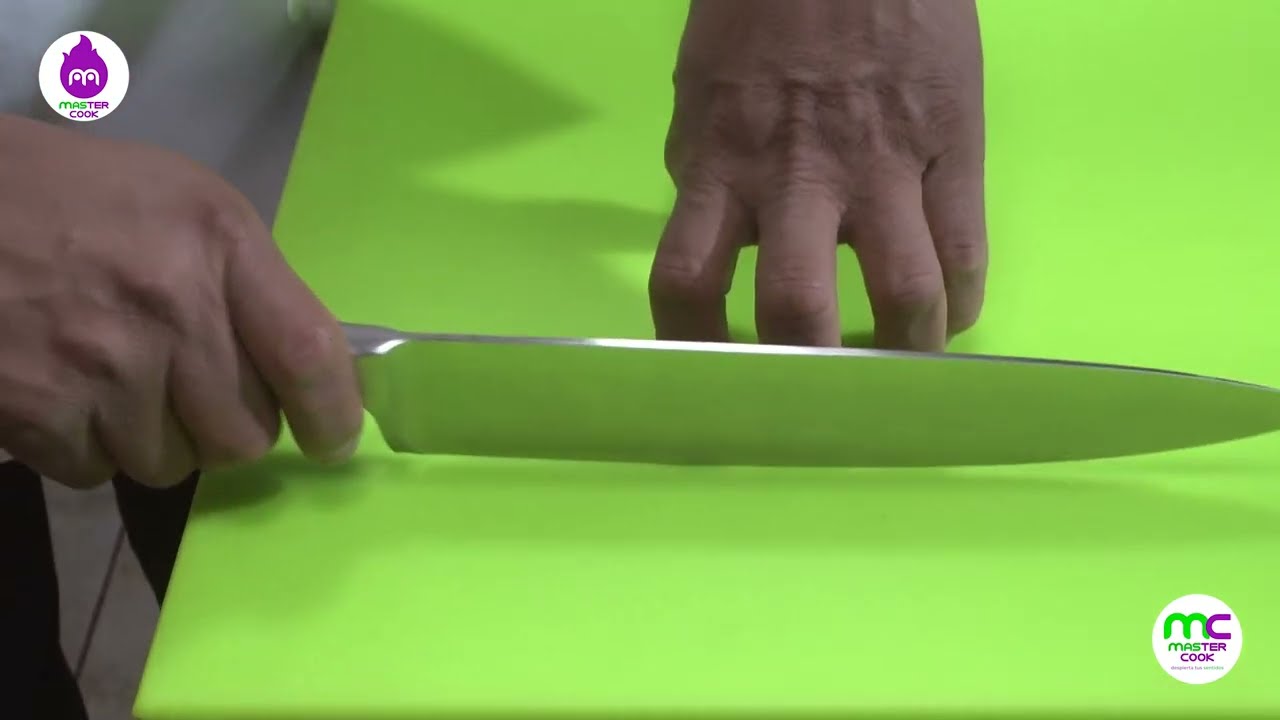
5Correct knife grip: Hold the knife perpendicular to the board. Most professional knives have a bolster (a small indentation where the blade meets the handle) — place your index finger on the blade side of this bolster and wrap the remaining four fingers around the handle. The handle must not extend past your palm. This grip gives maximum control. Common beginner errors include gripping too tightly (hold it like a newly hatched chick — firm enough not to drop, gentle enough not to crush), and extending the thumb along the spine.Tip: Gripping too hard causes fatigue, imprecision, and cramps. Grip pressure should be minimal — let the knife's weight do the work.
-
6The guiding hand ('crab claw'): The non-knife hand controls what you cut and sets the spacing. Curl all fingers so the nails are pressed flat against the cutting board (like a crab claw). The thumb tip must always touch the board — never raised. The side of the blade rests against the middle knuckle at all times, providing tactile feedback of where the blade is without needing to look. As you cut, the guiding hand retreats backward by the desired slice thickness — slowly, evenly, with all fingers moving together. Keeping nails short and unpolished is required for cooking.Tip: The most common injury for beginners is the ring finger or pinky lagging behind as the hand retreats. All fingers must retract together as a unit.
-
7Technique 1 — Free-fall (Caída libre): Used for large, dense items like large carrots, cabbage, whole poultry. Hold the knife up, keep the entire blade edge parallel to the board, and bring the blade straight down — or draw it toward you in a single pulling motion. This technique uses the full length of the blade. The knife does not stay in contact with the board between cuts — it is fully lifted each time.
-
8Technique 2 — Rocking cut / Pivot (Basculante / Pivote): The most-used technique (90% of professional cutting). The tip of the knife stays in contact with the board at all times and acts as a pivot point. The blade rocks up and forward, then is pulled back toward you in a counterclockwise arc — tip down and forward, handle up and back. The guiding hand retreats with each cut to set the slice width. Practice this technique until it is smooth and automatic — it is the foundation of speed and precision in professional cooking.Tip: The motion resembles a counterclockwise circle: call toward you, drop down, push forward, lift, call toward you again. Never lift the tip off the board during this technique.
-
9Technique 3 — Tip-drag (Punta y arrastra): Used mainly with smaller, flexible knives for fine work — especially cutting onion into fine strips. The tip of the knife is placed down, and the handle end is drawn forward and dragged across the ingredient. Used for chiffonade (plumas) and very fine julienne cuts.
-
10Knife safety rules: (1) Never carry a knife alongside a cutting board — the knife stays on the board, the board travels alone. (2) Keep the cutting board clean — after each cut, sweep trimmings into a bowl with a clean board stroke, then resume cutting. (3) When moving around the kitchen with a knife, hold it point down, blade facing backward, pressed against the thigh. (4) To pass a knife to a colleague, grip the blade firmly by the spine (non-sharp back edge) and offer the handle — hold steady so the recipient can grasp the handle firmly before you release. (5) If a knife falls, do NOT try to catch it — step back and let it fall.Tip: All professional cooks carry scars from learning. The cuts come from bad technique, not the knife itself. Learn the correct habits and they will become automatic.
Cultural Context
In professional Peruvian and Spanish culinary training, mastery of the knife is treated as a foundational discipline. Victor Heredia, a Lima-trained chef teaching at Master Cook, emphasizes that the knife is the extension of the cook's hand and that dominating it determines how quickly, efficiently, and safely one can work in the kitchen — a mindset shared across the classical French, Japanese, and Latin culinary traditions.
Victor Heredia
APRENDA A USAR EL CUCHILLO COMO UN PROFESIONAL #tecnica #cocina #cortes #seguridad #rapido #receta
Watch on YouTube →