› Browse Recipes › This Bread is TOO Easy To Be This Good...
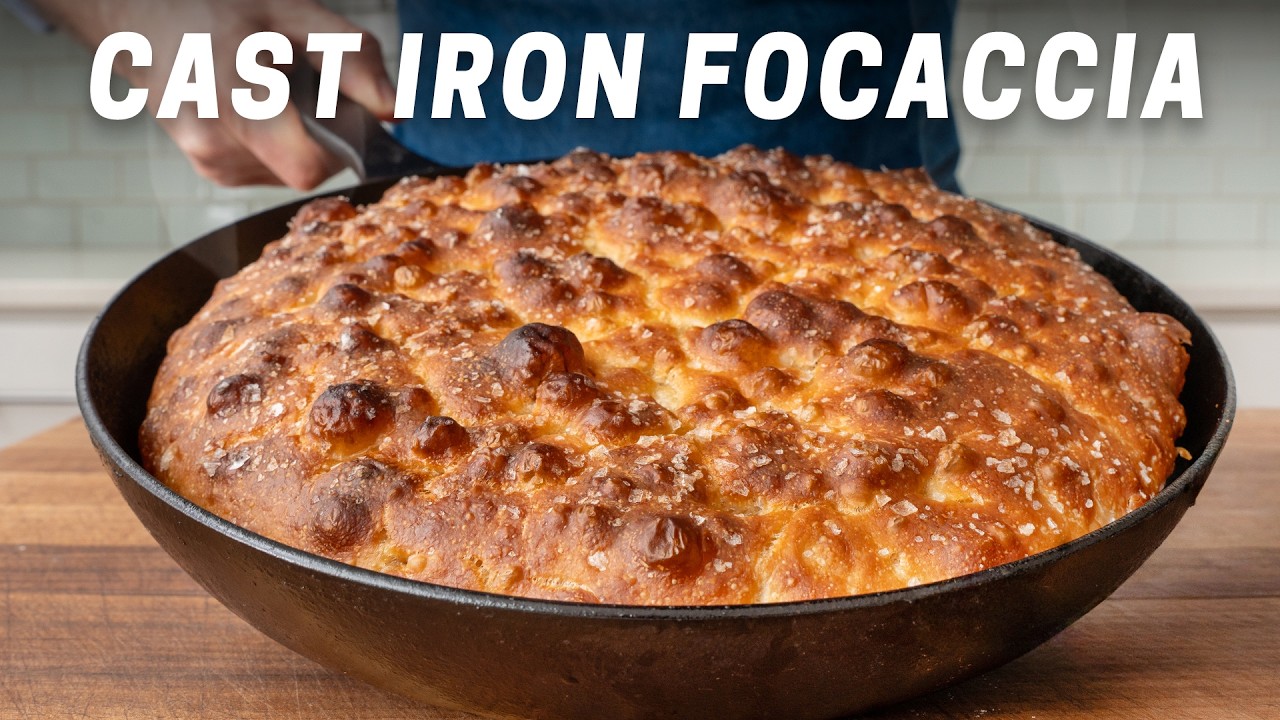
This Bread is TOO Easy To Be This Good...
A go-to cast iron focaccia recipe that is crispy and deeply golden on the outside, airy and soft inside, made with a surprisingly low amount of effort. No stand mixer required, just one pan and a little time for bakery-level bread at home.
smart_display Published 2026-04-05
download Extracted 2026-04-11
Ingredients
- 360 g warm water (90F/31C) (at 90F/31C temperature)
- 10 g sugar
- 25 g extra-virgin olive oil (for the dough)
- 450 g bread flour (12.7% protein)
- 4 g instant yeast (dissolved in warm water)
- 20 g warm water for dissolving yeast and salt (at 90F/31C temperature)
- 12 g salt (dissolved in warm water with yeast)
- ¼ cup or more extra-virgin olive oil (for the pan and drizzling on top)
- for finishing flaky salt (for topping)
Steps
-
1In a bowl, combine 360g warm water (90F/31C), sugar, 25g olive oil, and 450g bread flour. Mix with a sturdy spoon until combined, then switch to a wet hand and squeeze the dough until no lumps remain. Use a dough scraper to push any hydrated dough from the sides back into the mass.Tip: Water temperature is critical — too cold and the dough goes slow; too hot and it over-ferments. Use a thermometer or bath-warm water.~5 min
-
2Cover the bowl and rest for 30 minutes. This is the autolyse — hydrating flour without salt or yeast to develop a stretchy, soft dough with a more open crumb.Tip: Autolyse builds gluten strength without kneading — the dough becomes much more extensible.~30 min
-
3Mix 20g warm water with 4g instant yeast and 12g salt until dissolved. Pour the yeast-salt mixture into the autolysed dough and mix with a wet hand for about 60 seconds until no dry clumps remain.Tip: Salt and yeast combined briefly in water is fine — they only interact harmfully after 30+ minutes.~2 min
-
4Cover and ferment for 30 minutes.~30 min
-
5Perform a stretch and fold: with a wet hand, grab the dough, pull it up as far as it will go, fold it back over itself, rotate the bowl slightly, and repeat 4–5 times around the bowl. The dough should feel noticeably stronger and less sticky.Tip: Stop folding when the dough resists stretching — that's the gluten tightening up.~3 min
-
6Flip the dough seam-side down and round it into a ball using a 10-to-2 motion (like clock hands) to build surface tension. Cover and rest 30 minutes.~30 min
-
7Perform a second round of stretch-and-fold, then round the dough again into a tight ball as before.~3 min
-
8Cover and refrigerate for 4–24 hours (cold fermentation/overnight rest).Tip: Longer cold ferment = more complex flavor. You can bake after 4 hours but overnight is ideal.~240 min
-
9Add about ¼ cup olive oil to a 12-inch cast iron pan. Transfer the cold dough to the pan, bottom-side up. Oil your fingertips and dimple and gently stretch the dough to fill the pan. If it springs back, wait a few minutes and try again.Tip: Flipping the dough bottom-side up exposes the less-developed surface, helping it stretch more evenly.~5 min
-
10Cover and proof for 60 minutes in a warm spot (70F+).~60 min
-
11Drizzle more olive oil over the top of the dough and dimple again pressing firmly 10–12 times all the way to the pan bottom.Tip: Press all the way to the pan bottom — this creates the signature dimpled texture.~2 min
-
12Cover and proof for another 30 minutes until doubled, jiggly, and bubbly.~30 min
-
13Preheat oven to 500F/260C.~15 min
-
14Top with flaky salt.~1 min
-
15Bake for 15–18 minutes until deeply golden.Tip: You want a very deep golden crust — don't pull it early. The cast iron retains heat so the bottom keeps cooking.~18 min
-
16Remove from pan immediately and cool on a wire rack for 15–20 minutes before cutting.Tip: Removing immediately prevents the bottom from steaming and softening in the pan.~20 min
Nutrition (por porción)
280
Calorías
7g
Proteína
42g
Carbohidratos
9g
Grasa
2g
Fibra
Cultural Context
Focaccia is a classic Italian flatbread originating from Liguria, particularly associated with the city of Genoa. It is one of Italy's oldest breads, with roots going back to ancient Rome. Cast iron focaccia adapts the traditional sheet-pan technique to home kitchens, delivering an ultra-crispy bottom crust from direct contact with the seasoned iron while maintaining the characteristic airy, open crumb.