› Browse Recipes › Cacio e Pepe Pizza (with the Ice Trick)
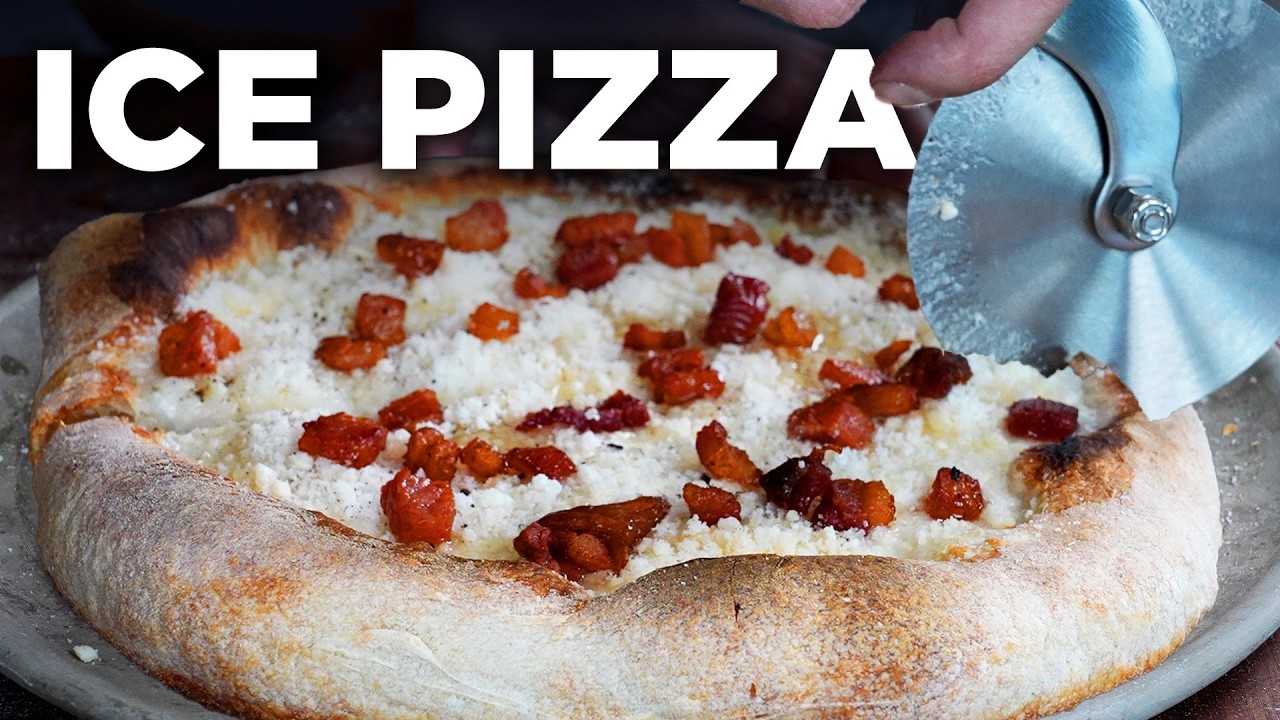
Cacio e Pepe Pizza (with the Ice Trick)
A Roman-inspired cacio e pepe pizza built on a homemade starter and 63% hydration bread-flour dough. Ice cubes placed on the rolled-out base melt into starchy 'pasta water' during the bake, forming a creamy emulsion with pecorino, parmesan, and black pepper once finished. An optional guanciale topping turns it into pizza alla gricia.
smart_display Published 2026-04-29
download Extracted 2026-05-05
Ingredients
Optional Gricia Topping
- to taste guanciale (diced and rendered crispy; reserve the strained fat) opcional
Pizza Assembly (per pie)
- to cover ice cubes (small ball-shaped cubes preferred)
- to cover pecorino romano cheese (finely grated; about 2 parts pecorino to 1 part parmesan)
- to cover parmesan cheese (finely grated; mixed with pecorino at a 1:2 ratio)
- to taste freshly cracked black pepper
- as needed flour (for shaping and dusting the peel)
- as needed cornmeal or semolina (for the pizza peel)
Pizza Dough
- 220 g active starter (from the starter above)
- 345 g room temperature water
- 10 g sugar
- 15 g olive oil (added in two halves)
- 615 g bread flour (12.7% protein)
- to taste fine salt (added after the 20-minute autolyse rest)
Starter (made 1+ days ahead)
- 200 g room temperature water
- 4 g instant yeast (about half a 7g packet)
- 200 g bread flour (12.7% protein)
Steps
Bake the Pizza
-
1On baking day, place a pizza steel on the middle rack and preheat the oven to 550 F (or its highest setting) for at least 3 hours. Remove the dough balls from the fridge and let them temper at room temperature.Tip: A long oven preheat ensures the steel keeps recovering its heat after each pizza, just like a wood-fired oven.~180 min
-
2Dust a board with flour. Scrape the dough out of its container and onto the board, treating the rougher bottom side as the top of the pizza. Coat both sides lightly with flour, then press firmly around the edge with your fingertips to set the cornicione (crust rim), choking it off from the center. Flip and repeat on the other side.Tip: The imperfect side becomes the top because it gives texture to the base, while the smooth side fries beautifully against the steel.~2 min
-
3Press out the center, then place a palm in the middle and stretch the dough outward, rotating after each push. Stretch the disc smaller than usual to emphasize the puffy crust, since there will be no sauce or cheese in the center to weigh it down.Tip: Take your time; you do not need speed for this stretch.~2 min
-
4Dust a pizza peel with flour and cornmeal (or semolina). Transfer the dough onto the peel and shake to confirm it slides freely. Pile small ice cubes generously into the center, like you would mozzarella, leaving the rim clear.Tip: Small ball-shaped ice cubes work especially well; the goal is a real pool of water once they melt.~2 min
-
5Slide the pizza onto the preheated steel and bake for 1-2 minutes, until the crust starts to puff up around the pool of melting ice.Tip: The puffy rim acts as a cradle that holds the starchy 'pasta water' in the center.~2 min
-
6Switch the oven to broiler and finish baking, rotating the pizza for even browning. You want the crust to brown evenly and the dough to crisp underneath while a pool of water remains in the center.Tip: If your broiler is broken, just keep baking at max temperature until the crust is colored.~4 min
Finish the Cacio e Pepe
-
1Pull the pizza out, making sure there is still plenty of liquid in the center; that is your pasta water. Mix grated pecorino and parmesan (about 2:1 pecorino to parm) generously into the pool, agitating with a spoon to form a creamy emulsion across the base.Tip: Without enough liquid you will end up with grated cheese on top instead of an emulsion; if needed, add a few drops of hot water.~1 min
-
2Top with another light dusting of grated cheese and a heavy crack of fresh black pepper. Serve immediately as cacio e pepe pizza.Tip: Treat the final dusting like the cheese on a finished pasta plate.~1 min
Optional Gricia Topping
-
1Optional gricia step: dice the guanciale, place in a pot over medium-high heat, and slowly render until the fat is liquid and the cubes are crispy. Strain through a fine sieve, reserving both the crisp guanciale and the rendered fat.Tip: Save every drop of fat: it gets drizzled on the finished pizza for the gricia transformation.~12 min
-
2To make pizza alla gricia: drizzle some of the reserved guanciale fat over the cheese emulsion, then scatter the crispy guanciale on top. Slice and serve.Tip: Just like cacio e pepe pasta becomes gricia with guanciale, the pizza follows the same rule.~1 min
Pizza Dough
-
1In the bowl of a stand mixer, combine 220 g of the active starter with 345 g room temperature water. Fit the dough hook and run on low to break the starter into the water.~2 min
-
2Add 10 g sugar and half (about 7-8 g) of the 15 g olive oil. Begin adding the 615 g bread flour gradually, a small scoop at a time, allowing each addition to hydrate before the next. As the mixture stops looking soupy, increase the mixer speed slightly.Tip: Adding flour gradually mimics the fresh-pasta well technique and creates more even hydration faster.~5 min
-
3Once all the flour is in, add the remaining olive oil. Stop the mixer, cover the dough with a towel, and rest 20 minutes. Do NOT add salt yet.Tip: This rest is an autolyse: the dough relaxes and gluten begins to develop on its own.~20 min
-
4Add the salt and run the mixer for 6 minutes. The dough will go from sticky and ragged to a tighter ball that pulls cleanly off the sides of the bowl.Tip: The dough is at 63% hydration, so it starts sticky but becomes tackier and workable as the gluten develops.~6 min
-
5Rest 5 minutes, mix 6 minutes, rest 5 minutes. Test the windowpane: stretch a piece of dough thin without it tearing. If it tears, give it another 5 minutes of mixing followed by a 5-minute rest, and repeat until you achieve the windowpane.Tip: The dough is not infinitely extensible; it just needs to feel easy to work and stretch thinly without tearing.~25 min
-
6Tip the dough onto a board. Do a few slap-and-folds: pick it up, slap it down, fold it over itself to build tension. Then shape it into a ball using your palms, pushing up, over, and pulling back to create a tight, sealed bottom.~3 min
-
7Place the dough in a bowl, cover tightly, and bulk-ferment at room temperature for 3-4 hours. You want jiggle, an airy look, and bubbles forming around the surface, not necessarily a doubling.Tip: It is OK if the dough does not double; you are looking for a fermenting, proofing characteristic, not a specific volume.~240 min
-
8Divide the dough into about five 220-230 g balls. For each, fold the dough on itself and shape it tight using the same up-over-pull-back motion. Place each ball in its own covered container and refrigerate for 24 hours (up to a few days).Tip: Make at least one larger ball if you want flexibility for different pizza styles.~1440 min
Starter (made 1+ days ahead)
-
1Make the starter at least one day (and up to a few days) ahead. In a container, combine 200 g room temperature water with about 4 g (roughly half a packet) of instant yeast. Stir, then add 200 g bread flour and stir until fully hydrated and sticky. Scrape down the sides.Tip: Use less yeast for a slower, more flavorful fermentation. The total weight stays at 400 g no matter how much it rises.~5 min
-
2Cover with a lid, mark the level with a rubber band, and refrigerate. If using the next day, leave at room temperature for about an hour first to kick-start activity, then refrigerate overnight. Look for a loose, airy, web-like structure with lots of bubbles, not a specific volume increase.Tip: If you skip a feeding, scrape the gunk off the sides, add more flour and water, and the starter keeps going indefinitely without needing fresh yeast.~720 min
Nutrition (por porción)
520
Calorías
18g
Proteína
65g
Carbohidratos
20g
Grasa
2g
Fibra
Cultural Context
Cacio e pepe is one of the four classic Roman pasta dishes, alongside carbonara, gricia, and amatriciana. It relies on the emulsion of starchy pasta water with pecorino romano cheese and freshly cracked black pepper to create a creamy sauce without cream. This pizza version, popularized in Italy by Neapolitan pizzaioli including Chef Fausto, uses ice placed on the raw dough to mimic the role of pasta water: as the pizza bakes, the ice melts and combines with the flour dust on the dough, producing the same starchy liquid that emulsifies the cheese. Adding crisped guanciale at the end converts the pie into pizza alla gricia, mirroring how cacio e pepe pasta becomes gricia with the same addition.
NOT ANOTHER COOKING SHOW
The Secret Ingredient To The Most Unique Pizza I've Ever Made
Watch on YouTube →