› Browse Recipes › Cooking from Boiling Liquid — English-Style Blanching & Poaching Techniques
Cooking from Boiling Liquid — English-Style Blanching & Poaching Techniques
A foundational culinary technique lesson covering how to cook ingredients by immersing them in boiling liquid (water, stock, wine, or milk) to preserve nutrients and color. Demonstrates English-style blanching, scalding (escaldado), and poaching with practical examples using peas and basil.
download Extracted 2026-04-01
Ingredients
demonstration — English-style boiling
- peas (fresh or frozen) (whole)
- water (brought to a rolling boil)
- salt (added to boiling water)
- ice (combined with cold water for ice bath)
demonstration — blanching (escaldado)
- fresh basil (whole leaves)
Steps
-
1Bring a pot of salted water to a rolling boil. The water must already be boiling before adding any ingredient — this is what distinguishes this technique (cocción por concentración / 'English-style') from starting in cold water.Tip: The boiling liquid can be water, stock (fondo), wine, milk, or sugar syrup (almíbar) — the principle is the same.~5 min
-
2Add the ingredient (e.g., peas) directly to the boiling salted water. The boiling water instantly forms a protein film around the product, sealing in nutrients and pigmentation — this is the 'concentration' effect.Tip: Green vegetables must NEVER be covered while cooking — always leave the pot uncovered.
-
3Cook peas for approximately 5 minutes (cooking time depends on altitude — at 3,200 m above sea level, water boils at ~92°C, so adjust accordingly).~5 min
-
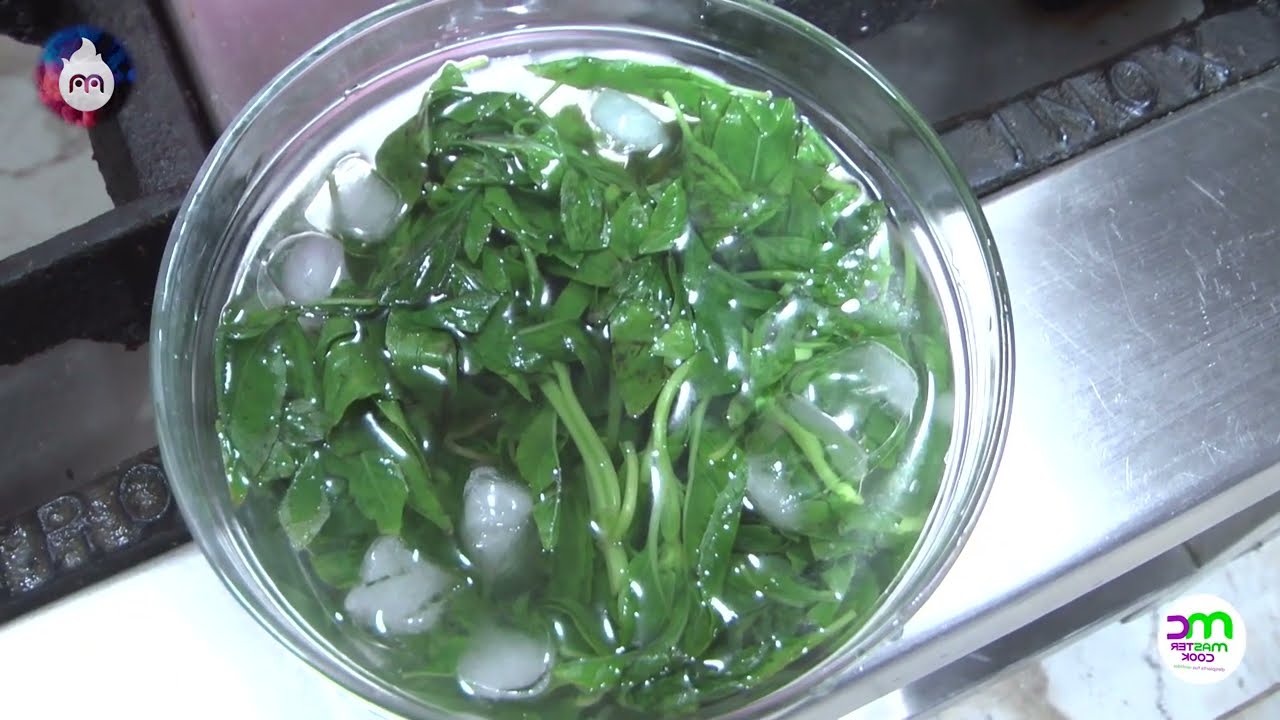
4Immediately transfer the cooked peas to an ice bath (water + ice). This 'abatimiento' (thermal shock) stops the cooking instantly and preserves the vivid green color.Tip: The ice bath takes the temperature from ~92°C down to ~1°C, fixing the bright green pigmentation.~2 min
-
5For blanching (escaldado): bring a second pot of salted water to a boil. Add basil leaves, stir briefly, and remove IMMEDIATELY (a matter of seconds). This eliminates the carbonic acid (anhídrido carbónico) that would cause the basil to oxidize and turn grey when blended.Tip: Any green product destined for blending must be blanched first to remove carbonic acid and preserve color and flavor.~1 min
-
6Immediately transfer blanched basil to an ice bath. The basil retains its nutrients, flavor, and a vibrant, fresh green color — ideal for pesto or green sauces.Tip: If basil had been started in cold water instead, all its pigmentation and flavor would leach into the water.~2 min
Cultural Context
This lesson by Peruvian chef Victor Hugo Heredia Tapia is part of a culinary fundamentals course aimed at gastronomy students, home cooks, and food entrepreneurs. The technique known as 'cocción a la inglesa' (English-style cooking) is a cornerstone of classical culinary training worldwide. Chef Heredia teaches from Huancayo, Peru — at over 3,200 meters above sea level — where water boils at lower temperatures (~92°C), making correct technique even more critical.