› Browse Recipes › Homemade Sushi — Salmon Roll, Shrimp Tempura Roll & Fried Roll
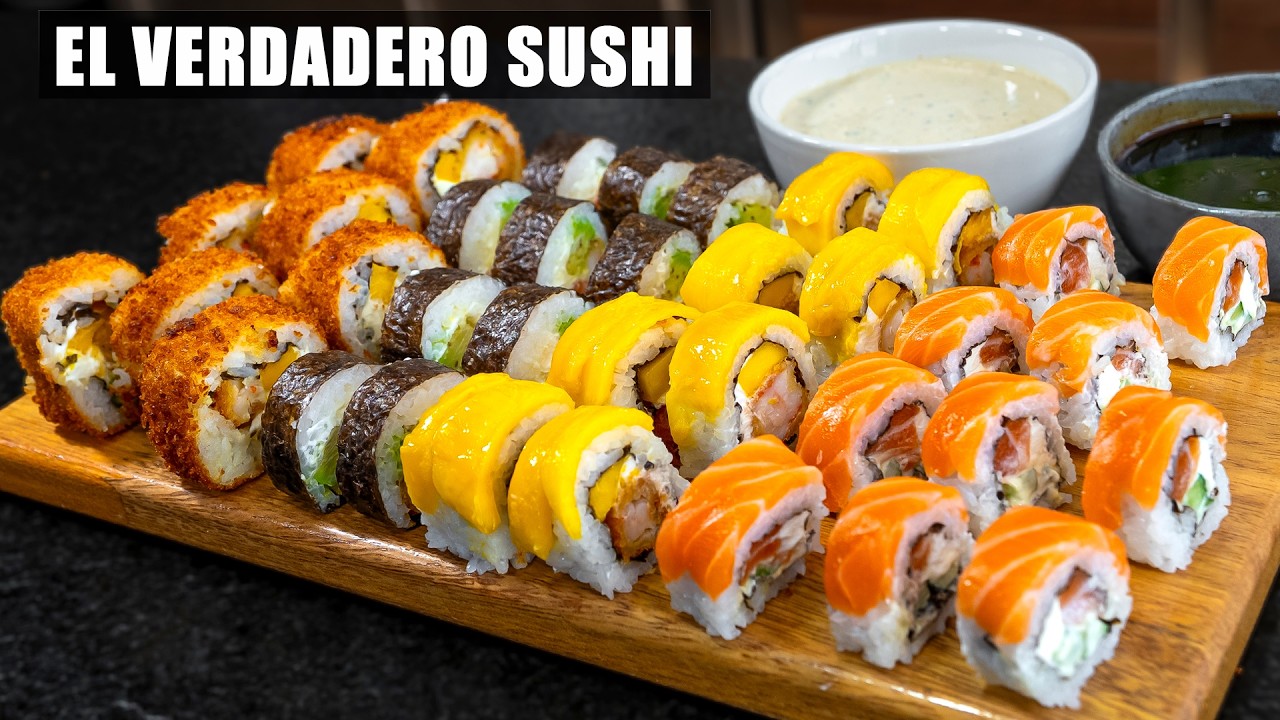
Homemade Sushi — Salmon Roll, Shrimp Tempura Roll & Fried Roll
Easy homemade sushi tutorial covering three roll styles: a classic salmon inside-out roll, a shrimp tempura roll with mango, and a deep-fried roll. Includes homemade sushi rice with vinegar seasoning, tare sauce, and a ceviche-style aioli.
smart_display Published 2026-04-23
download Extracted 2026-04-27
Ingredients
Ceviche Sauce
- 1 whole egg (for homemade mayonnaise base)
- to emulsify vegetable oil (added gradually to form mayonnaise)
- to taste black pepper
- a pinch seasoning (all-purpose) opcional
- to taste salt
- a touch mustard opcional
- a small piece ají amarillo or ají limo (Peruvian yellow chili) opcional
- a touch fresh ginger opcional
- 1 clove garlic clove
- a small piece onion
- 3 limes lime juice (juiced)
- a handful fresh cilantro stems opcional
- a touch paprika or fondashi (Japanese dashi powder) (paprika for color, fondashi for umami) opcional
Roll Assembly
- as needed nori seaweed sheets (cut in half with scissors)
- to taste cream cheese (placed in a small piping bag for easy application)
- a touch mayonnaise opcional
- as needed avocado (cut into thin sticks) opcional
- 1 mat bamboo sushi mat (wrap with plastic film to prevent sticking)
Salmon Roll
- as needed salmon fillet (skin removed; cut into thin sticks for filling and sliced thin for topping)
- as needed zucchini (curie) (cut into thin sticks with skin on) opcional
Shrimp Tempura Roll
- as needed large shrimp or langostinos (deveined, butterflied, flattened to break muscle fiber, marinated in egg-pepper-mustard mix then breaded in flour and panko)
- as needed mango (cut into thin sticks for filling and sliced thin for topping decoration) opcional
- as needed all-purpose flour (for breading shrimp and fried roll)
- as needed panko breadcrumbs (Japanese breadcrumbs)
- as needed eggs (beaten, for breading and shrimp marinade)
- enough for deep frying vegetable oil (heated in a deep pan for deep frying)
Sushi Rice
- 2 cups sushi rice (glazed or short-grain round rice) (rinsed 3-4 times until water runs clear)
- 2 cups water
- 0.25 cup rice vinegar (or apple cider vinegar or white vinegar)
- 2 tbsp white sugar
- 0.5 tsp salt
Tare Sauce
- 100 ml soy sauce
- 40 ml mirin (rice wine liqueur) opcional
- 4 tbsp brown sugar
- 100 ml water
- 4 slices fresh ginger opcional
- as needed to thicken cornstarch (dissolved in a little water) opcional
Steps
Ceviche Sauce
-
1Make the ceviche aioli: blend egg and oil together to form a homemade mayonnaise base. Season with black pepper, seasoning salt, mustard, a small piece of ají amarillo, fresh ginger, a garlic clove, a piece of onion, the juice of 3 limes, and fresh cilantro stems. Add paprika or fondashi for color and umami. Taste and adjust salt.Tip: Both paprika (for color) and fondashi/dashi powder (for Japanese umami) work — use whichever you can find.~8 min
Fried Sushi Roll
-
1For the fried roll: assemble a roll with cream cheese, avocado slices, salmon, and fried langostino (cut in half to reduce thickness). Seal the ends with extra rice. Coat lightly in flour, dip in beaten egg, then coat in panko. Deep fry for approximately 4 minutes until golden all over. Use two tongs to remove carefully.Tip: Add extra rice at the roll ends before breading to seal the filling inside during frying.~8 min
Roll Assembly
-
1Wrap the bamboo sushi mat in plastic film to prevent sticking. Cut nori sheets in half with scissors. Place a nori sheet rough-side up on the mat.~2 min
-
2Take a small portion of sushi rice and spread it evenly across the entire nori sheet, leaving a small margin at the far edge so the roll seals cleanly. Press gently so the rice adheres to the nori.Tip: Add rice little by little if you don't get the quantity right the first time.~3 min
-
3To cut all rolls: use a sharp knife and wet it with water before each cut to prevent sticking and crumbling. Cut each roll in half first, then cut each half into individual pieces. Work quickly without sawing back and forth.Tip: For added cutting stability, place a small plastic bag under the roll as support. The seaweed on the outside helps hold the shape.~5 min
-
4Plate all three sushi varieties. Serve with tare sauce drizzled on top or on the side, and the ceviche aioli as a dipping sauce. Enjoy immediately.Tip: The ceviche sauce ties everything together with its citrusy, spicy kick. The tare adds the sweet, umami depth.~2 min
Salmon Roll
-
1Prepare the salmon: remove the skin and cut into thick sticks for filling. Separately, slice some salmon into thin sheets to use as topping decoration on the finished rolls.Tip: Salmonada trout (salmon-colored farmed trout) is identical to salmon and a great substitute.~5 min
-
2For the salmon roll (uramaki): flip the nori so the rice faces down onto the plastic-wrapped mat. Pipe or spread cream cheese across the nori, add a touch of mayonnaise, then place salmon sticks and zucchini sticks in a line.~3 min
-
3Roll tightly using the mat, pressing in stages, always applying light pressure. Tuck the mat edges inward to compact the sides of the roll. Place thinly sliced salmon on top, press again with the mat to mold, then remove the mat.~3 min
Shrimp Tempura Roll
-
1Prepare the langostinos (shrimp): remove the shell and devein by making a cut along the back. To prevent curling during cooking, lay each shrimp flat and press gently with three fingers, moving from front to back, to break the muscle fiber on the underside. Marinate with beaten egg, black pepper, and a touch of mustard for 5 minutes.Tip: The flattening step is key — it breaks the fiber that causes shrimp to curl, so they stay straight inside the roll.~10 min
-
2Bread the marinated shrimp: dust lightly with flour, dip again in beaten egg, then coat in panko breadcrumbs, pressing gently so the crust adheres well.Tip: Alternatively, blanch the shrimp in boiling water instead of frying if you prefer a lighter option.~5 min
-
3Deep fry the breaded shrimp in abundant hot oil in a deep pan. Do not touch for the first 2 minutes to let the crust form. Total frying time is 4 to 5 minutes until golden and crispy. Drain and set aside.Tip: Deep frying means fully submerged in enough oil that the shrimp cook evenly on all sides.~7 min
-
4For the shrimp tempura roll (heavy furai): repeat the rice and nori setup. Flip the nori. Add cream cheese, mango sticks, and the fried langostino. Roll tightly in stages with gentle pressure. Decorate the top with thin mango slices and press once more with the mat to hold the shape.~5 min
Sushi Rice
-
1Rinse the sushi rice 3 to 4 times in cold water, rubbing gently, until the water runs completely clear. This removes excess starch for the correct sticky-but-separate texture.Tip: Glazed (uruchimai) rice or round short-grain rice both work. Do not use long-grain rice.~5 min
-
2Place the rinsed rice in a pot with 2 equal cups of water. Cook over low heat for approximately 14 to 15 minutes, then turn off the heat and let it rest covered for 10 more minutes.Tip: Equal parts rice and water — 2 cups rice to 2 cups water.~25 min
-
3While the rice cooks, make the rice vinegar seasoning: combine the vinegar, 2 tablespoons of white sugar, and 1/2 teaspoon of salt in a small pot over low heat. Stir until the sugar and salt dissolve completely, then remove from heat.~5 min
-
4Transfer the rested rice to a wide, flat container. Drizzle the vinegar seasoning little by little over all the rice while mixing with a paddle or large spoon to distribute evenly. Fan or let cool to room temperature before using.Tip: Add the dressing gradually so every grain is coated without becoming mushy.~5 min
Tare Sauce
-
1Make the tare (eel) sauce: combine soy sauce (100 ml), mirin (40 ml), brown sugar (4 tbsp), water (100 ml), and ginger slices in a small pot. Bring to a boil and simmer for 10 to 15 minutes until slightly reduced and the sugar begins to thicken the sauce.Tip: If mirin is unavailable, substitute 1 teaspoon of rice vinegar. If the sauce doesn't thicken, add a cornstarch slurry (cornstarch dissolved in water) little by little, then simmer 1.5 more minutes to cook the starch.~15 min
Nutrition (por porción)
420
Calorías
22g
Proteína
52g
Carbohidratos
14g
Grasa
3g
Fibra
Cultural Context
This recipe reflects the widespread Latin American adaptation of Japanese sushi, where local flavors like mango, ceviche-style aioli, and langostino (large shrimp) are incorporated into classic maki rolls. The 'acevichada' sauce — a citrusy, spicy mayonnaise-based condiment — is a distinctly Peruvian-influenced fusion touch increasingly common across South America.