› Browse Recipes › The Most Important Burger in American History (Modernized White Castle Slider)
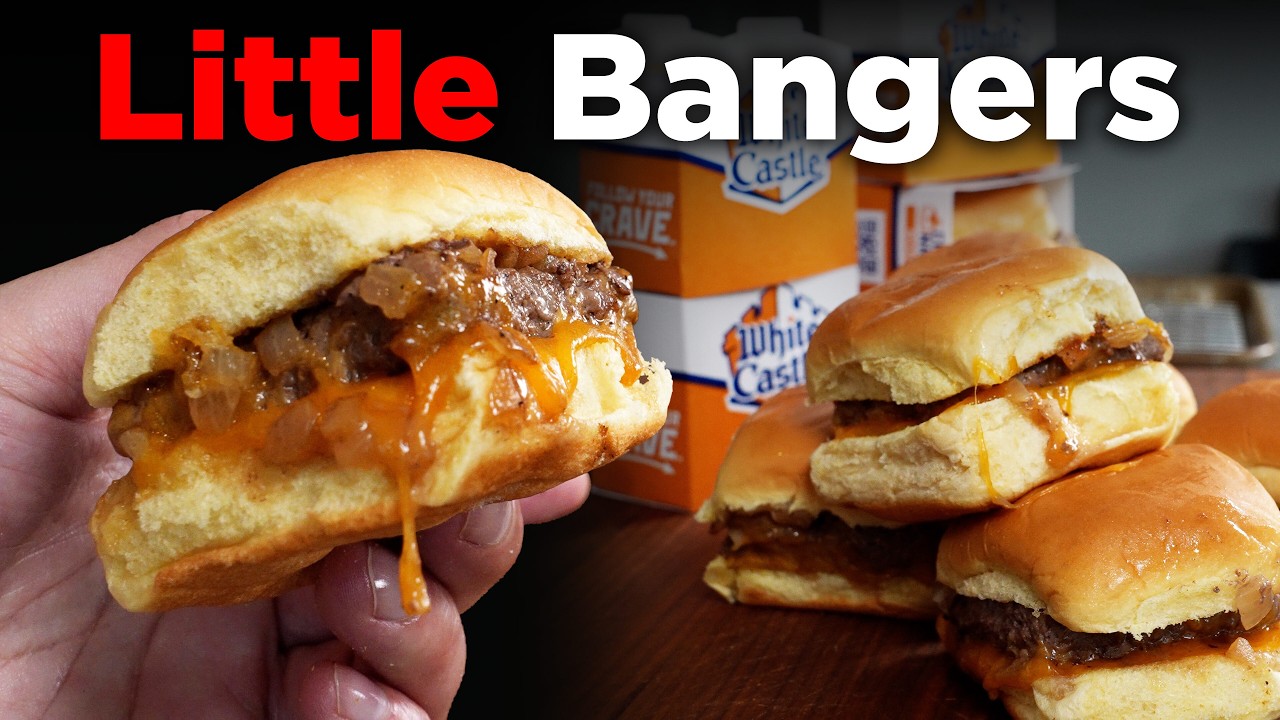
The Most Important Burger in American History (Modernized White Castle Slider)
A modernized take on the original White Castle slider. The classic steam-cooked, holed square patty is upgraded by searing one side for a caramelized crust, then finishing it steamed on a bed of fresh and rehydrated dried onions. The result keeps White Castle's iconic onion flavor while fixing its main weakness: flavor.
smart_display Published 2026-05-20
download Extracted 2026-05-22
Ingredients
- 2 lb 80/20 ground chuck (freshly ground)
- 1 large fresh onion (finely diced)
- as needed dried onion flakes (rehydrated in water (reserve the onion water))
- as needed American cheese slices (cut to the size of the patties)
- as needed cheddar cheese slices (cut to the size of the patties)
- 25 rolls sweet potato dinner rolls (mini slider-style, split)
- as needed neutral cooking oil (for the griddle)
- to taste salt (for seasoning onions and both sides of the patties)
- to taste pickle slices (for serving) opcional
- to taste ketchup (for serving) opcional
Steps
-
1Place about 1 pound of the 80/20 ground chuck inside a large Ziploc bag (or between two parchment-lined sheet trays). Press the meat outward toward the corners with your hands, then use a rolling pin to roll it into an even, flat sheet.Tip: The amount of meat you use dictates how thick each patty is. Make them as thin or thick as you like.~5 min
-
2Using a ruler, measure and cut the meat sheet into 2.5 by 2.5 inch squares, roughly three across and four down. Work any trim and scraps into new squares until you have about 25 patties.~10 min
-
3Make five small holes in each patty: one in the center and four around it. The holes let steam pass through to cook the frozen patty evenly, and let melted cheese seep through into the burger.Tip: This is the signature White Castle technique that makes the burger cook evenly straight from frozen.~5 min
-
4Transfer the patties to the freezer and chill for at least 30 minutes (or several hours until fully hardened). Detach the squares before they freeze solid, then bag them up for storage.Tip: Make a few now and pack the rest away in the freezer for quick future meals.~30 min
-
5Rehydrate the dried onion flakes in water and reserve both the onions and the water. Finely dice the fresh onion. Cut the cheese slices down to the same size as the patties.Tip: Combining fresh and dehydrated onion gives both classic onion flavor and the unique White Castle onion flavor, like a garlic bread that uses both fresh garlic and garlic powder.~10 min
-
6Preheat a carbon steel griddle over front and back burners until hot. Add a little oil and spread it across the surface with a spatula. Pour the diced fresh onions onto the griddle and season with salt.~3 min
-
7Cradle the onions toward the center into a long mound and let them steam. To brown them evenly, pull the far onions toward you and use a scraper to flip the near onions over the mound. Once they begin to turn translucent and caramel, add the rehydrated onions and incorporate them into the mix.~8 min
-
8Push the browned onions to the back burner and lower the back heat so they slowly caramelize. Pull some frozen patties from the freezer and season the first side. Place the seasoned side down on the griddle in a pattern of about six patties at a time and season the other side.~2 min
-
9Place a press down on the patties to get good contact and a really good sear on the first side. Allow that first side to develop color, then add some of the reserved onion water to the griddle to act as steam.Tip: Searing the first side is the modernization that gives flavor White Castle's purely steamed patty lacks.~3 min
-
10Once the burgers are browning around the edges, pick them up and flip them onto the bed of onions to finish steaming the second side in the onions and onion water.~2 min
-
11As soon as the patties are on the onions, place a piece of cheese on each (cheddar on some, American on others). Set a bottom bun on top of the patty, then a top bun on top of the bottom bun to trap the steam, melt the cheese, and warm the buns.~2 min
-
12Once the cheese is melted and the burger has cooked through, pick up the patty, take the top bun off, and close up the sandwich. Use your thumbs to pinch the burger out, flip it right side up, and rest it on a wire rack. Repeat to cook the remaining batches.Tip: Six burgers cook in just a few minutes.~5 min
-
13Serve the sliders as they are or add a pickle and a hit of ketchup to some. Pack the rest up to take with you.~2 min
Nutrition (por porción)
230
Calorías
12g
Proteína
16g
Carbohidratos
13g
Grasa
1g
Fibra
Cultural Context
White Castle, founded in Wichita, Kansas in 1921, was America's first fast food restaurant. It pioneered the standardization of process across all locations and the speed-of-service model that every fast food chain from McDonald's to In-N-Out later adopted. At a time when ground beef had a bad reputation following Upton Sinclair's 1906 expose 'The Jungle' (which led the public to believe burgers were made from scraps of diseased animals), White Castle single-handedly rehabilitated ground beef in the American diet. Its signature technique is unusual: square frozen pucks of beef with five slotted holes are placed over a bed of rehydrated dried onion flakes and onion water on a griddle, the holes letting steam pass through to cook the patty evenly without ever touching the grill, while the buns placed on top trap the steam. White Castle is also an onion burger that predates the famous Oklahoma fried onion burger by roughly a decade. This recipe honors that history while borrowing the searing technique from White Castle's burger successors to deliver real flavor.