› Browse Recipes › How to Fillet a Fish — Masterclass with Chef Khabir Tello
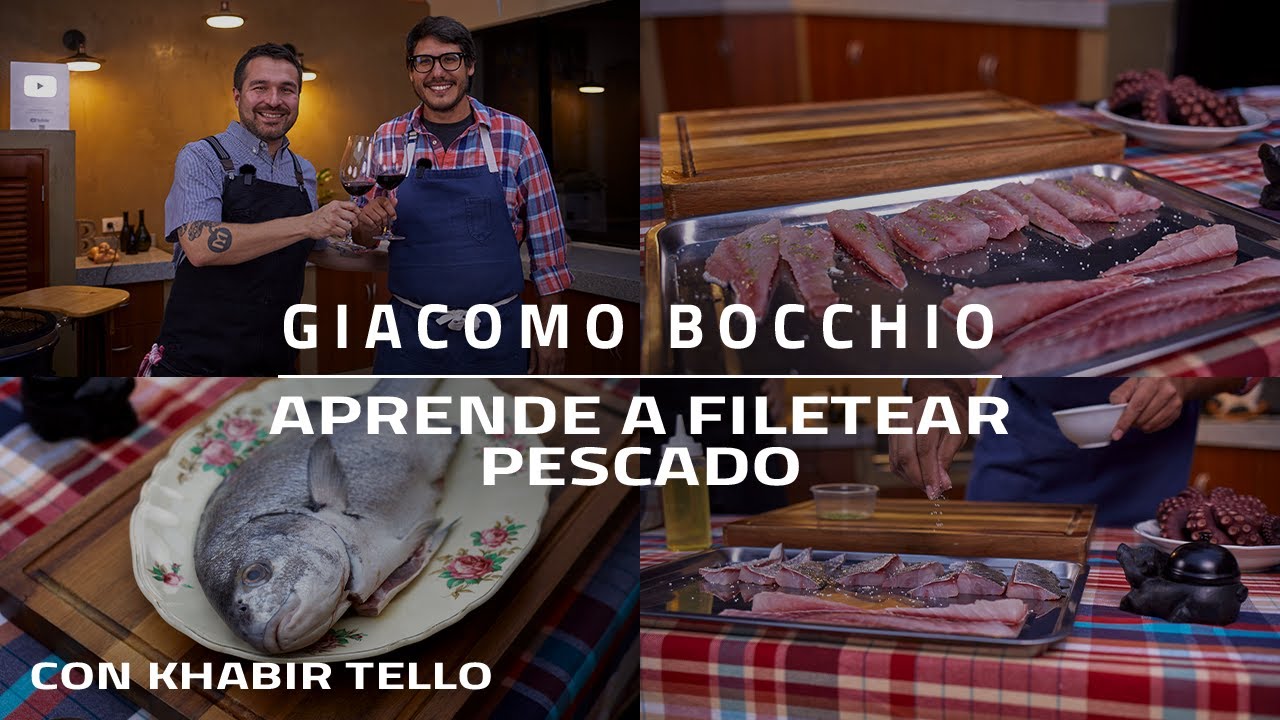
How to Fillet a Fish — Masterclass with Chef Khabir Tello
A masterclass in fish filleting and portioning taught by expert diver and chef Khabir Tello alongside Giacomo Bocchio. Using a fresh 1.5 kg chita (Peruvian grunt / sargo), Khabir demonstrates professional techniques for removing the head, filleting both sides cleanly along the spine, separating the loin from the belly, trimming the lateral line and bloodline, and portioning ('detailing') the fillet for even cooking. The video also covers knife choice, handling hygiene, the swim bladder, the ikime bleeding technique, and how fresh fish should look.
download Extracted 2026-03-31
Ingredients
No ingredients listed
Steps
-
1Inspect the fish. The subject is a fresh chita (Peruvian grunt / sargo, Anisotremus scapularis) weighing approximately 1.5 kg. Confirm freshness: the flesh should be bright, glossy, and firm.Tip: A fresh fillet will be visibly bright and shiny. Any dullness or fishy odour indicates the fish is past its prime.~1 min
-
2Remove the head. Make a 45-degree angled cut behind the head, toward the rib bones, on both sides of the fish. Locate the joint, apply light leverage with the knife, then pull and cut cleanly — no force needed. Removing the head before filleting gives you a flat surface, preventing the fillet from bending and making your cuts far more accurate.Tip: In the kitchen everything can be done elegantly — there is no need for force or messy cuts. Find the joint and use leverage, not strength.~2 min
-
3Fillet the first side. Starting at the loin (from the very top of the back, not a few fingers back), make a single, clean, decisive cut along the length of the fish, keeping the knife blade parallel to and riding along the spine. When you reach the vertebral column, angle the knife up to go over and around it, then come back down — this avoids leaving flesh on the bones.Tip: Make long, frank strokes — never short, sawing cuts. Excessive manipulation and warm hands damage the flesh. Listen for the sound of the knife riding the bones; that sound confirms correct technique.~3 min
-
4Fillet the second side. Flip or reposition the fish. Push the fish into a slight curve so the skin is under tension — this helps the knife glide cleanly. Repeat the same single, clean stroke along the spine, arcing over the vertebral column. Rest the fillet against the board and minimise handling.Tip: For large fish (10–15 kg+), keep the fillet resting flat on the board and work from the loin side, opening the muscle like turning pages — never lift and stretch.~3 min
-
5Check the carcass. Pass a spoon along the backbone — no flesh should come off. A well-filleted spine of a 1.5 kg chita will have minimal waste. If small pin bones (puntas de espina) remain at the belly area, they can be removed with fish tweezers (pinzas).~1 min
-
6Separate loin from belly. Run the knife along the lateral line of the fillet — there are no bones there — making a single clean cut to split the loin (lomo) from the belly (panza). The belly piece can be reserved for frying; use the loins for plating.Tip: The lateral line runs the full length of the fish and is easy to follow visually — it is also where the bloodline is concentrated.~1 min
-
7Remove the lateral line and bloodline. Trim away the dark red band (línea de sangre / línea lateral) running along the fillet. This is where capillaries and veins are densely concentrated; some diners find the flavour too strong. Leave it on the skin side if the plan is skin-on cooking — the skin will become crispy and mask it.Tip: The lateral line contains pressure-sensing pores that the fish uses to detect water movement. Its intense red colour comes from the high concentration of capillaries keeping it permanently irrigated.~1 min
-
8Detail (portion) the fillets for even cooking. 'Detailing' means squaring up the fillet and cutting it into portions of equal thickness so that every piece cooks at the same rate. Measure roughly one hand-span (una cuarta) per portion. Separate the tail piece, which is thinner and more fibrous — it will need less cooking time. Cut straight across with a single decisive stroke; do not saw, as the fish flesh will shred.Tip: A thick end and a thin tail tip will never cook evenly together. Cutting to equal thickness is the single most important step for a professional result.~2 min
-
9Season the portions. Sprinkle lightly with salt and add lemon zest (cest de limón). Use only the green part of the zest — the white pith is bitter. At high cooking temperatures the essential oils in the green zest will activate and perfume the fish beautifully.Tip: Grate only the outermost green layer of the lemon. Stop as soon as you see white — that bitterness cannot be corrected.~1 min
-
10Cook skin-side down (unilateral). For a causa or grilled presentation, cook the fillet exclusively on the skin side (cocción unilateral). The skin crisps up and forms a golden crust that finishes the presentation and masks the bloodline.Tip: Unilateral cooking preserves moisture in the flesh while delivering texture contrast from the crispy skin — a hallmark of refined Peruvian seafood cookery.
Cultural Context
The chita (Anisotremus scapularis), also known as sargo, is a prized reef fish found along the Peruvian coast, particularly in shallow, well-oxygenated waters. It is a staple of Peruvian coastal cuisine and is frequently used in causa, ceviche, and grilled preparations with crispy skin. The tradition of line-fishing for chita is deeply embedded in Peruvian coastal life — Giacomo recalls fishing for them as a child in Tacna. Professional filleting skill is considered a mark of culinary seriousness in Peru; the ikime technique (Japanese spike-and-bleed method) has been adopted by top Lima restaurants such as those of chef Adolfo Perret (Punta Sal) to maximise freshness, texture, and shelf life. Chef Khabir Tello, a freediving spear-fisherman and former culinary school instructor, represents a growing movement of cook-fisherman who source their own seafood directly from the sea.
Giacomo Bocchio
¿CÓMO FILETEAR UN PESCADO? | CLASE MAESTRA JUNTO AL CHEF KHABIR TELLO | #GIACOMOBOCCHIO
Watch on YouTube →